
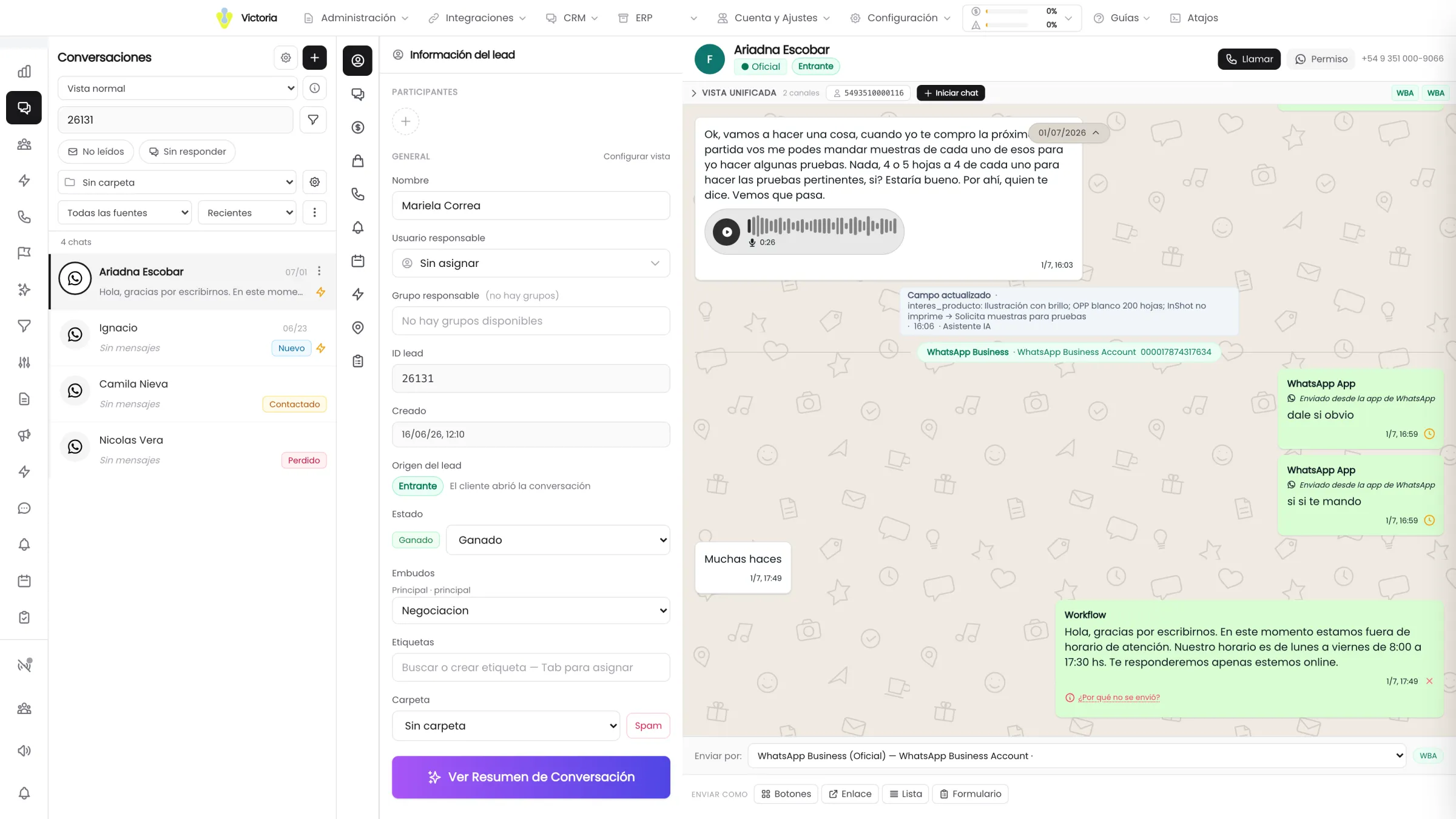
Leads with no fast reply
A lead that gets no reply within minutes is very likely to go to a competitor. After hours and in demand peaks, the team cannot keep up.
An instant reply, 24 hours a day, on every channel. No lead goes cold waiting.
It answers, qualifies, quotes, collects payment and loads the order into your ERP. On every channel, 24 hours a day, with nobody on the team stepping in.
Replies instantly · WhatsApp, Instagram, Facebook, TikTok and voice calls

Seven bottlenecks that show up in almost every sales operation. They are described in the words of the team that suffers them.
A lead that gets no reply within minutes is very likely to go to a competitor. After hours and in demand peaks, the team cannot keep up.
An instant reply, 24 hours a day, on every channel. No lead goes cold waiting.
Sales reps forget to load the customer data and the history ends up incomplete. Opportunities are not recorded and the pipeline stops reflecting reality.
The agent loads the lead data into the CRM: name, channel, history, intent and stage. Without anyone typing a thing.
The customer asks for a price and the rep takes hours to put the quote together. By the time it arrives, the customer has already picked someone else. A slow quote is a lost sale.
Instant quoting: a formal quote as a PDF or prices straight into the message. The customer gets the proposal before changing their mind.
Once the customer accepts, someone has to type the order into the ERP or POS by hand. Human error is guaranteed and the operator time is lost.
The agent loads the order into the ERP or POS as soon as the payment is confirmed, with the items, the quantities and the prices from the conversation.
Customers who asked and did not buy never get followed up. The pipeline fills with open opportunities nobody moves along.
The agent detects the intent, creates the opportunity in the CRM and follows up until it closes or is handed off to a person.
Coordinating the logistics of the order takes manual work: call the customer, contact the courier, confirm the times. A chain of errors on every delivery.
The agent coordinates the shipment with PuniYa or another delivery platform, inside the same conversation.
Managers do not know how many leads come in, what converts and what does not close. Commercial decisions are made without data from the real process.
Reports asked for in plain language over real system data: pipeline, conversions and performance per rep.
The agent feeds the CRM. The CRM holds up the pipeline. The reports show where every sale came from.
The same agent handles every channel at once, with the history unified per customer. And every channel has its own page: what comes in, what goes out and where the limit is.
The agent takes phone calls and WhatsApp calls: it answers questions, takes the order, quotes and processes the payment out loud. The call is recorded in the CRM with its duration, its summary and its transcript.
The agent speaks with the tone and the identity of your company: it is trained on the way you communicate and on the full catalog.
The channels one by oneFrom the first message to the order loaded into the system and the shipment coordinated.
Through WhatsApp, Instagram, Facebook, TikTok, a Twilio call or a WhatsApp call.
The agent replies instantly, whether the team is busy or it is the middle of the night.
It asks the key questions, understands the need and fills in every field in the CRM.
Price, stock and availability are read from the ERP or the POS at the moment of replying, not from a list loaded last week.
A formal quote as a PDF or prices straight into the message, depending on the context.
If the customer goes quiet, the opportunity stays open in the CRM and the agent picks the conversation back up when it is due.
A Mercado Pago link or bank transfer details, inside the conversation.
The payment is verified on its own and the customer gets an automatic confirmation.
It is recorded in the ERP, the POS or the management system, with its items and prices.
The shipment is requested from PuniYa or another delivery platform, with no calls and no spreadsheets.
If the customer needs it, the agent generates a quote PDF with the company logo, the items, the prices and the terms. For quick questions it sends the prices straight into the message, with no document.
When the payment is confirmed, the order is recorded straight into the business management system — as a quote, a delivery note or whichever document applies. No operator ever types the order again.
PuniYa is integrated and switched on from day one. PedidosYa is in progress. If you use another platform or your own fleet, the connection is built to measure.
When the enquiry calls for it, the agent escalates to the right rep inside the CRM, with the whole conversation loaded and the opportunity already open. The person walks in with context, not from scratch.
Every step leaves a trail in Victoria CRM: the lead, the conversation, the opportunity, the quote and the order all hang off the same customer record.
How it connects to your management systemVictoria integrates with your ERP, your POS, your management system and the delivery platforms. There is no migration and no parallel system.
The ERP integration is bidirectional: the order is recorded in real time and the prices and the stock are always read from your system. Payment goes through a Mercado Pago link with automatic verification of the credit, or through an alias or CBU with automatic confirmation. If you use another delivery platform or your own fleet, we build the connection.
See all the integrationsSaying where the limit is, is part of the offer. The agent executes what the company decides it should execute.
The agent executes every action we give it tools for: quote, collect payment, load the order, coordinate the shipment, modify or cancel. The more access it has to your system, the more it resolves end to end.
Every sensitive action can require human confirmation. When the agent wants to create, modify or close an opportunity, the proposal waits for approval. It is configured action by action.
Approvals allow exceptions per time slot and per day, and rules for what to do when the lead has no assigned owner: ask for confirmation, assign in rotation or apply it directly.
When the case needs a person, the agent escalates to the right rep with the whole conversation loaded and the opportunity open. Everything is recorded in the CRM.
Every agent action and every approval is audited inside the platform.
See security and dataThe same process for any sales operation. Between 1 and 3 weeks.
We map the sales process and connect Victoria to your ERP, POS or management system. If the connection does not exist, we build it.
We load the full catalog, the price lists, the business rules and the tone your company speaks with. We define what requires human approval.
We deliver a test version, your team uses it, and we apply the changes until the agent sells the way you expect.
It goes into production on every configured channel. After that we keep adjusting flows, answers and scope with your sales team.
A full 7-stage process, between 1 and 3 weeks.
See the full processIn 30 minutes we review your channels, your management system and your sales process, and tell you what gets automated first.
Rollout in 1 to 3 weeks · Without changing the system you already use.